

AUTOSAR is an open software architecture developed through collaboration between automotive manufacturers (OEMs), Tier-1 suppliers, semiconductor manufacturers, and software vendors. Its objective is to establish a standardized software platform that allows automotive applications to be developed independently of the underlying hardware.
Instead of redesigning software for every new ECU or vehicle platform, developers can create reusable software components that communicate through standardized interfaces. This modular approach reduces engineering effort, improves software quality, and simplifies long-term maintenance.
The primary goals of AUTOSAR include:
- Standardizing automotive software architecture across the industry.
- Improving software portability between different hardware platforms.
- Promoting software reuse across multiple vehicle programs.
- Enabling seamless communication between Electronic Control Units.
- Reducing development complexity and integration effort.
- Supporting safety-critical automotive applications.
- Simplifying system integration for manufacturers and suppliers.
As modern vehicles continue to incorporate additional electronic functions, these objectives become increasingly important for managing software complexity while maintaining reliability and safety.
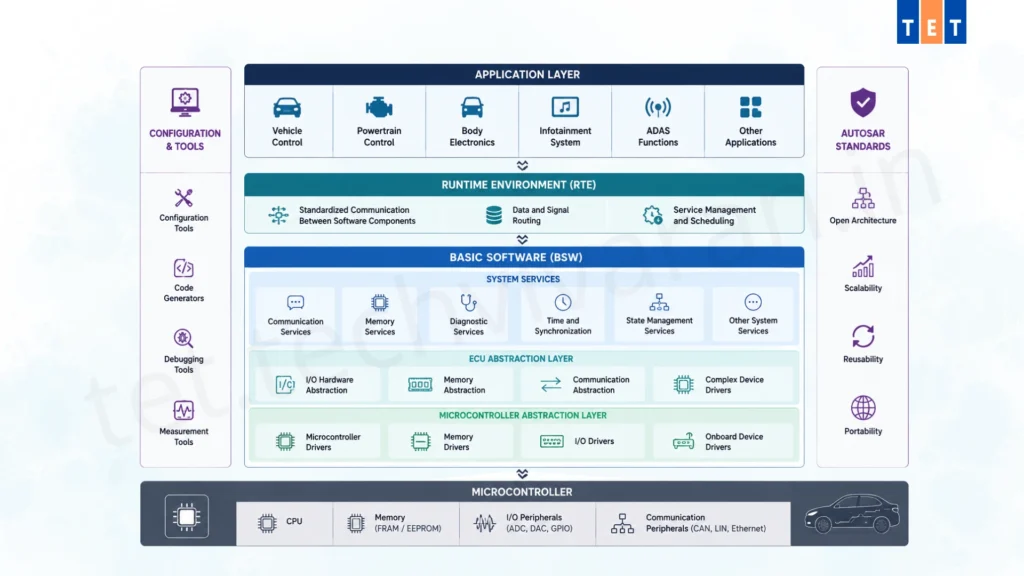
Autosar Platforms
To meet the diverse computing requirements found in today’s vehicles, AUTOSAR defines two complementary software platforms.
Autosar Classic Platform
The Classic Platform is designed for embedded ECUs that require deterministic, real-time operation. These controllers typically manage functions where predictable execution timing is essential, such as engine management, braking systems, steering, airbags, and body electronics.
Its layered architecture provides a lightweight and highly reliable software environment that operates efficiently on resource-constrained microcontrollers.
Autosar Adaptive Platform
The Adaptive Platform addresses the requirements of high-performance computing systems used in modern vehicles. Unlike the Classic Platform, it supports dynamic applications, service-oriented communication, and powerful multicore processors running POSIX-compliant operating systems such as Linux.
This platform is intended for computationally intensive applications, including autonomous driving, advanced driver assistance systems, vehicle connectivity, cloud-based services, and over-the-air software updates.
Together, the Classic and Adaptive Platforms provide a comprehensive software foundation capable of supporting both traditional embedded controllers and the next generation of intelligent automotive computing systems.
Key Electronic Control Units
The information collected from sensors is processed by specialized ECUs distributed throughout the vehicle. AUTOSAR provides standardized communication mechanisms that allow these controllers to exchange information efficiently and reliably.
Common ECUs include:
- ADAS ECU, responsible for advanced driver assistance functions.
- Gateway ECU, which routes communication between different in-vehicle networks.
- Body Control Module (BCM), managing body electronics such as lighting, doors, and windows.
- Infotainment ECU, supporting multimedia, navigation, and connectivity services.
- Airbag ECU, responsible for occupant protection systems.
- Engine Management System (EMS) ECU, controlling engine operation.
- Anti-lock Braking System (ABS) ECU, managing braking performance.
- Vehicle Control Unit (VCU), coordinating overall vehicle behavior, particularly in electric vehicles.
Each ECU performs a dedicated role while remaining connected to the broader vehicle network through AUTOSAR’s standardized software architecture.
Benefits of AUTOSAR
AUTOSAR simplifies automotive software development by providing a standardized and modular architecture. It promotes software reuse across multiple vehicle platforms, reducing development time and costs. By separating application software from hardware, it improves portability and simplifies ECU integration. Additionally, AUTOSAR enhances interoperability between components from different suppliers and supports the development of reliable, safety-critical automotive systems.
Challenges and Limitations
Despite its advantages, AUTOSAR introduces additional complexity due to its layered architecture and extensive configuration requirements. Developers often require specialized tools and expertise to implement AUTOSAR-based systems effectively. Furthermore, the abstraction layers may increase memory and processing overhead, making optimization important for resource-constrained ECUs.
Future of AUTOSAR
As vehicles become more connected and software-driven, AUTOSAR continues to evolve to meet new industry requirements. While the Classic Platform remains essential for real-time embedded systems, the Adaptive Platform supports high-performance applications such as autonomous driving, vehicle connectivity, and over-the-air software updates. Its ongoing development ensures that AUTOSAR remains a key technology for future automotive software architectures.
Conclusion
AUTOSAR has become the industry standard for automotive software architecture by providing a scalable, modular, and hardware-independent framework. It simplifies software development, improves interoperability, and enables efficient integration of complex vehicle systems. As automotive technology advances, AUTOSAR will continue to play a vital role in building reliable, connected, and intelligent vehicles.
