

The STM32 microcontroller’s secret weapon is Direct Memory Access (DMA). Smoother multitasking and quicker reaction times are guaranteed by allowing peripherals to move data directly to and from memory without the need for the CPU. We’ll go over how DMA functions, detailed use cases, and the reasons it’s crucial for modern embedded systems in this article.
What is DMA?
Direct Memory Access (DMA) is a hardware feature that allows peripherals to transfer data directly to or from memory without CPU involvement. This means the CPU can focus on other tasks while data moves efficiently in the background.
How It Works?
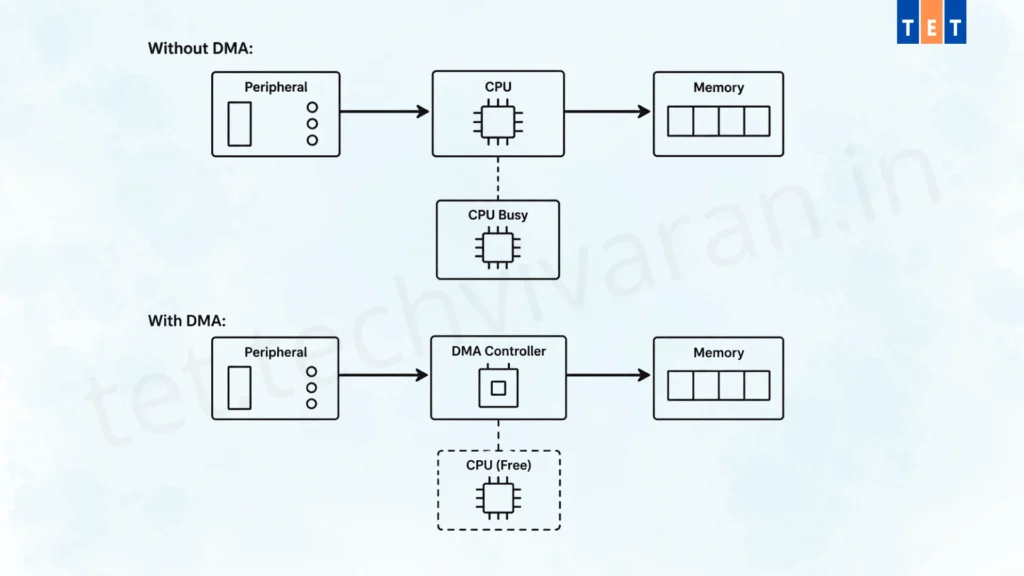
Without DMA: Data flows from Peripheral → CPU → Memory.
The CPU remains busy during the transfer.
With DMA: Data flows from Peripheral → DMA → Memory.
The CPU is free to handle other operations.
DMA in Action — Step by Step
1.UART TX DMA
- The CPU passes data to the DMA controller.
- DMA transfers the data directly to the USART transmitter (TX).
- The CPU remains free while the transfer is in progress.
Use case: Sending large amounts of data without blocking the CPU.
2. UART RX DMA (Fixed Size)
- DMA receives a predefined number of bytes from the USART receiver (RX).
- An interrupt is generated when the transfer is complete.
- Best suited for data packets with a known length.
Use case: Fixed-size commands, packets, or messages.
3. UART RX DMA + IDLE Line
- DMA continuously receives incoming data.
- An IDLE interrupt is triggered when the UART line remains inactive for one frame duration.
- This helps determine the end of variable-length messages.
Use case: GPS data, Modbus communication, and other variable-length protocols.
4. UART RX DMA + Circular Mode
- DMA continuously stores incoming data in a circular buffer.
- The buffer automatically wraps around when it reaches the end.
- No need to restart DMA after every reception.
- Often combined with IDLE Line Detection for continuous data processing.
Use case: Sensor data streams, logging systems, and real-time communication protocols.
Key Concepts to Remember
- DMA Write Position:
In Circular Mode, DMA continuously writes incoming data into a buffer. The write position indicates where the next byte will be stored and represents the current write index, not the total amount of data received.
- Ring Buffer Principle:
A ring buffer allows data to wrap around to the beginning once the end of the buffer is reached. DMA updates the write pointer while the application manages the read pointer, ensuring that only new data is processed.
- IDLE Line Detection:
When receiving variable-length data, STM32 can detect when the UART line becomes idle. This signals the end of a transmission, making it ideal for protocols such as GPS and Modbus where packet sizes are not fixed.
- CPU Offloading:
DMA transfers data directly between peripherals and memory without CPU involvement. This reduces CPU workload, improves multitasking, and increases overall system responsiveness.
- Reliable & Efficient:
DMA is widely used for continuous and high-speed data transfers such as sensor data acquisition, UART communication, SPI communication, audio streaming, camera interfaces, and SD card operations.
Why DMA Matters
- Improves system performance
- Reduces CPU overhead
- Enables high-speed data handling
- Crucial for real-time and multitasking systems
Typical Use Cases
- GPS modules
- Sensor data acquisition
- SD card or storage operations
- Communication protocols
- Camera or display data handling
DMA frees up your CPU for the most important tasks, such as GPS modules and sensor data streams. It is more than just a feature; it is a performance multiplier that increases the dependability, scalability, and efficiency of embedded systems.
